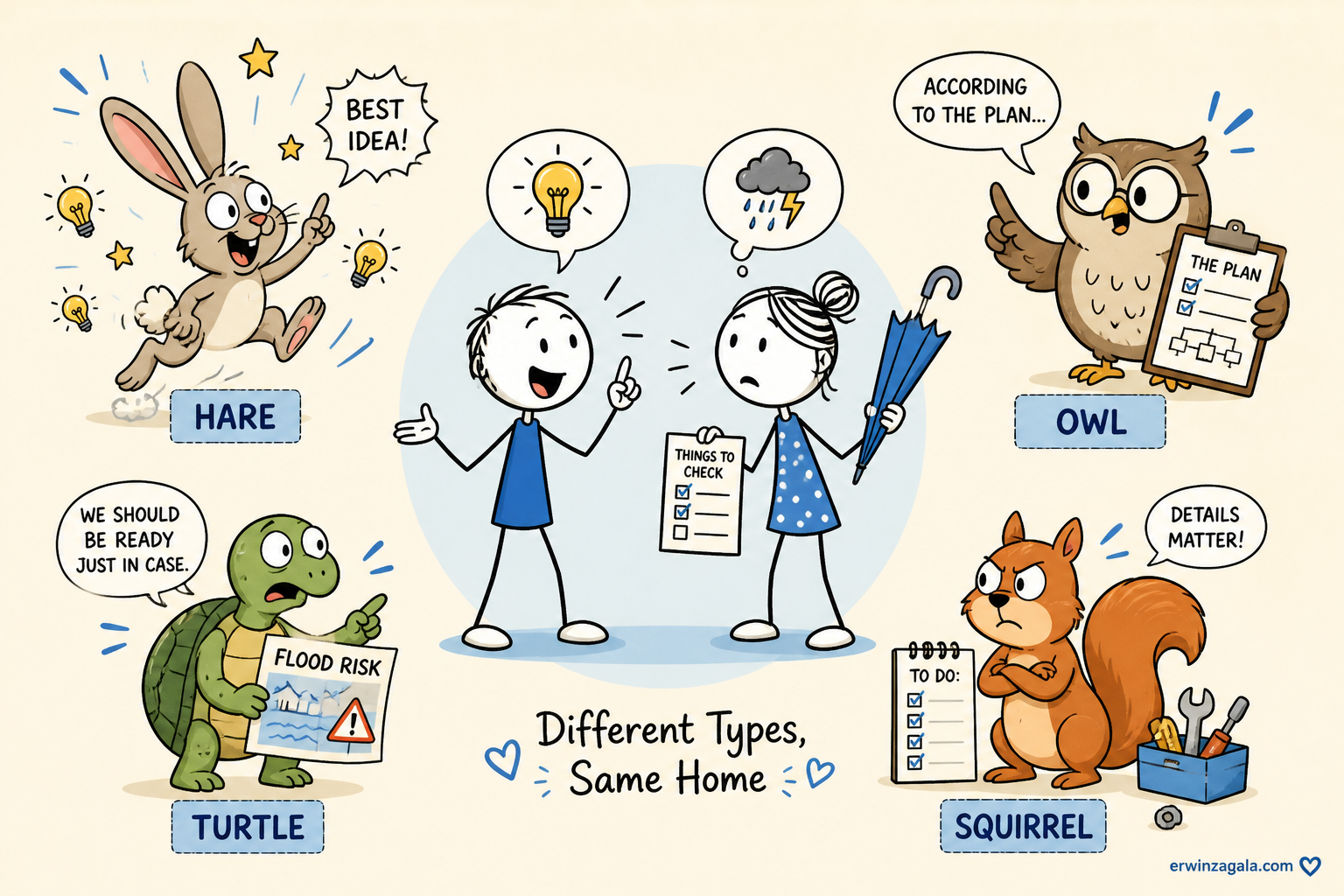
Earlier this morning, I was talking to Chari about going to the movies.
I was still thinking about what we could watch and which cinema to visit when the concerns started coming in.
Traffic. Flooding. Congestion. Cost.
And just like that, I didn't feel like going anymore.
I was trying to plant the seed of an idea. It felt like she was already checking whether the tree would damage the plumbing.
This dynamic has shown up many times in our relationship. I get excited about a possibility. She immediately sees the problems.
Before, it used to make me angry. Sometimes I took it personally. Why does every idea have to go through an interrogation? Can't we enjoy the possibility for a minute?
At my worst, I thought she was trying to undermine me. Killing the project before it had a name.
What I was hearing as "no" was closer to "not yet, and here is the flood map."
Two jobs in one conversation
Chari worked in banking for around fifteen years. A big part of that work was looking for red flags, checking details, and identifying what could go wrong before approving anything. Credit committees do not applaud enthusiasm. They look for the hole. Fifteen years of that does not stay at the office. It sits at the table and asks about parking.
Meanwhile, I'm an idea starter. I enjoy asking "What if?" I like walking around a possibility before I know exactly how it will work.
Put those two tendencies into one conversation and even a movie date becomes a committee hearing.
Same morning. Two different jobs. I thought I was being blocked. She thought she was doing diligence on a plan that did not exist yet.
I had been taking the hole-finding as a verdict on me. The list was not "you are reckless." The list was "I can see the water."
Four animals
A framework I encountered years ago helped me make sense of this.
In The One Minute Millionaire: The Enlightened Way to Wealth, Mark Victor Hansen and Robert G. Allen introduce team roles they call HOTS: Hare, Owl, Turtle, and Squirrel. You actually need one of each. A shop of only hares never leaves the driveway. A house of only turtles never starts the car.
In broad terms:
The Hare generates ideas. Conceptual, spontaneous. Reframes the problem. Looks for the option that is not on the form. Contribution: a direction that did not exist five minutes ago. Dark side: jumps to the next idea before the first one has a budget, a date, or a driver. Leave a hare alone to "refine" and they will solve the problem inside the problem inside the problem and lose the night out.
The Owl helps develop and advance the plan. Sees a new direction early and starts building the path — who does what, in what order, with what already works. Contribution: a plan other people can follow. Dark side: locks onto a method from the last project and forces this one through the same door. Careful planning can keep a discussion going long after you need to act.
The Turtle spots obstacles and risks. Believes consequences matter. Wants to know what happens if the sky opens over EDSA. Slow on purpose. Contribution: the flood before you drive into it. Dark side: filters out ideas that carry risk and payoff. Leave a turtle alone with a seed and nothing leaves the house.
The Squirrel handles the details and gets things done. One thing at a time. Logical. Execution. Contribution: the thing actually exists on Friday. Dark side: will not start until the hare has stopped talking, which, if you know a hare, is a long wait. Attention to detail can turn into resistance when the plan needs to change.
Hansen and Allen's rule of thumb: if you only have two people, pair opposites — hare with turtle, or owl with squirrel — or you go in circles. A balanced team is not a mood. It is coverage.
I recognize a lot of Hare in myself.
Give me a possibility and I can happily spend an afternoon exploring where it might lead. Ask me to finish every detail before entertaining another idea, and suddenly I need coffee.
Chari's instinct to check for problems reminds me of the Turtle. There may be Owl in it too — the part that will help sequence the night once there is something to sequence. I did not run her through a twenty-question survey over coffee. People are more complicated than four categories, and we play different roles depending on the room. The useful label is the one that stops me from inventing motive.
The framework gave me a better question than "why is she doing this to me?"
What if the thing that irritates me is also something we need?
Ideas need imagination. They also need planning, scrutiny, and follow-through. You need those contributions covered even if you do not have four separate people providing them.
That includes me. Being "the idea person" does not excuse me from listening or finishing things. My enthusiasm can leave other people with unfinished projects.
Timing, not a personality transplant
The adjustment Chari and I arrived at was mostly about timing. We did not fix this with a family workshop.
Give me room to explore first. Let me explain what I have in mind and put a rough plan together. Then help me find the weak spots.
Not while I am still holding the seed. After there is a seed.
The request sounds something like this:
"Can we explore the possibilities for a few minutes? After that, let's look at what might go wrong."
And I have to mean that second part.
If I ask her to save her concerns for later, then get defensive when later arrives, I am really just asking her to agree with me.
Her concerns deserve a proper hearing. Traffic, flooding, and cost can be perfectly good reasons to change a plan. My excitement does not make those things disappear.
If you reverse the hours, I feel attacked and she feels ignored. If you keep them in order, the night has a chance.
You can steal the sequence without marrying a banker.
-
Hare hour: possibilities only. No red flags yet. Write them down so they stop living only in the mouth.
-
Turtle hour: now the list. Traffic, flood, cost, the thing that breaks if it rains.
-
Owl hour: how we actually do it. Which mall. What time we leave. Who books.
-
Squirrel hour: the booking, the bag, the leaving the house.
Most fights I have watched — at home and at work — are two animals talking in the same minute and calling it a disagreement about the idea.
Agreeing on what we are doing in the conversation helps. Are we imagining possibilities? Choosing among options? Checking risks? Working out the details?
Those are different questions. Different animals should own them.
The team version
You already have these animals. You resent the one that is not you.
The hare in the meeting throws a new product on the table before the deck exists. You roll your eyes. Put that person at the start of the work, not at the sign-off, and you get options you would not have written.
The turtle only talks about what can go wrong. You call them negative. Put them after there is a draft, and they find the clause that would have wrecked you in month three.
The owl turns every conversation into a rollout. Fine — after there is something to roll out.
The squirrel wants the checklist and does not care how beautiful the vision slide is. Good. Someone has to leave the room with a task.
Adjustments that cost almost nothing:
At the start of a meeting, say which hour you are in. "Let's spend ten minutes generating options. Then we'll examine the strongest ones and decide what's practical." It is a slightly ridiculous sentence. It prevents a serious fight.
Do not ask the turtle to brainstorm. Do not ask the hare to risk-assess the brainstorm they just had.
If you only have two people, do not staff both seats with the same animal and hope variety appears.
Separate "is this a good idea" from "can this idea survive Tuesday in Manila."
Now the person who sees problems knows there will be space for those concerns. The person generating ideas gets a little room to think. And before everyone leaves, someone needs to turn the discussion into actual next steps.
What I am still practicing
I still enjoy having my ideas welcomed with enthusiasm. I suspect I always will.
I still flinch when the list starts. Traffic. Flood. Cost. The body gets there before the theory.
I am trying to treat the list as work, not as a verdict. Chari is trying to wait until there is a seed. Some mornings we manage it. This morning we still had to pick a cinema.
I am learning to appreciate what happens when someone sees something I have missed, even when the delivery arrives earlier than I would like.
You do not have to like the other animal. You have to stop making them the villain for showing up as trained.
Before the next conversation — at home or at work — agree on the task: explore first, examine next, then decide.
Put the hare on invention. Put the turtle on the flood. Then go to the movies.